Machine data acquisition in production
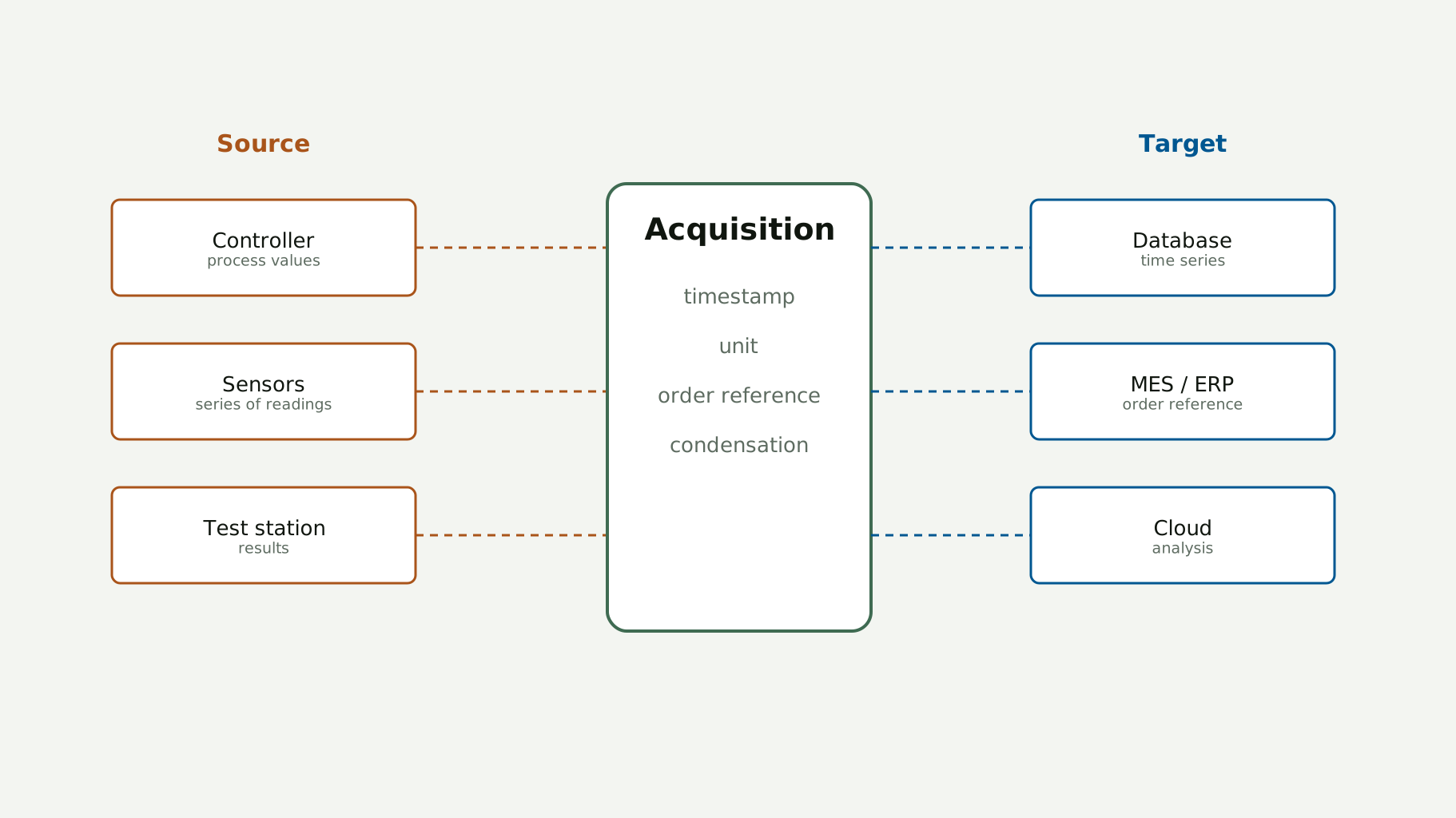
Machine data acquisition means reading out automatically the values that arise at the machine anyway, storing them with a timestamp and a reference, and giving them to whoever needs them. The effort rarely lies in the reading — it lies before that: which values, at what rate, with which reference, and into which target system?
Definition: machine data acquisition
Machine data acquisition means the automated reading, storing and analysis of data from networked machines. For many companies it is the first step of digitalisation — not because it is particularly difficult, but because everything else stands on it: without measured values there is nothing to compare, nothing to control and nothing to predict.
The benefit comes from transparency: when it is continuously visible what a machine is doing, production can be steered better, and weak points show themselves instead of being guessed at.
Two kinds of machine data
“Machine data” covers everything that can be fetched from a machine while it runs. In practice a distinction is worth making, because the two kinds are stored differently and used differently.
Simple data points
Process data recorded continuously or on change: a value plus a timestamp. From them a series arises through which a machine’s condition over time can be judged.
Connected records
Data with a clear reference — production order, material number, machine number, batch. Test results, consumption figures or traceability data hang off it. Only the reference turns a value into a statement about this product.
How the values get out
The precondition for all of it is continuous networking; in industry, IP-based networking has become the norm — over Ethernet, Wi-Fi or mobile. Modern controllers bring the network connection with them and only need to be switched on and configured.
| Route | What it does | What to watch for |
|---|---|---|
| OPC UA | Defines data access independently of the manufacturer, describes data structures and hierarchies and lets them be browsed. An acquisition built on it is extensible, platform-independent and works across industries. | The machine has to bring an OPC UA server with it, or have one put in front of it. |
| MQTT | Lightweight, for low bandwidth and weak devices. Runs over a broker on the publish/subscribe principle; the sender sets the topic per message. | For the content of a message MQTT prescribes no structure. Usually JSON or XML sits inside — sender and receiver have to agree outside MQTT. |
| Older machines | Existing controllers are connected over their own protocol and lifted onto the standard on the way. | Nothing works without a network connection; older protocols also often bring no security mechanisms with them. |
Poll on a cycle, or report on change
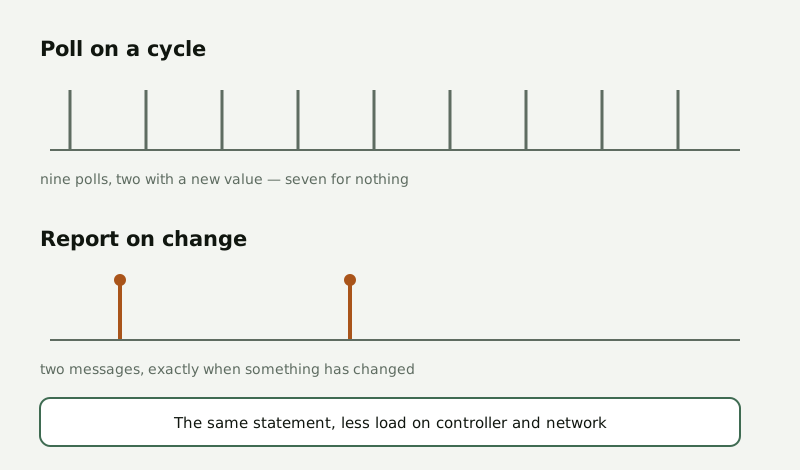
The same statement, two routes: nine polls at a fixed rate against two messages that arise exactly when something changes.
Polling at a fixed rate creates load — on the controller, on the network and in the database — even when nothing has changed. Being reported to brings entries only on a change. For states and counters that is almost always the better route; for slowly drifting readings a fixed rate can make more sense, because it delivers series without gaps.
Where the data belongs
If acquisition serves only one target system, that system usually stores the data too. As soon as several systems need the same values, a central database is the more sensible place.
- Relational database
- MS SQL Server, Oracle, MySQL: fixed table structures that various target systems draw on. The common normal case.
- NoSQL
- Loose structures instead of tables — document-oriented, time series, key-value, graphs. Sensible with large volumes and changing structure.
- Cloud
- Relational databases, NoSQL or a data lake; on top of that dashboards, monitoring and analysis up to machine learning. How it is delivered depends on the platform — often MQTT, sometimes OPC UA, sometimes straight into the database.
What acquisition changes in daily practice
Building it costs: networking, extending the controllers where necessary, software, and above all working time for planning and implementation. What stands against that is rarely one large item but a series of small ones:
- manual recording falls away
- response times fall, because the information is there immediately
- planning of staff and material becomes more accurate, because times and consumption are measured rather than estimated
- faults are passed on at once instead of being noticed on the next round
- maintenance cycles can be kept to and, in time, predicted
- what you tell customers becomes more reliable, for instance about delivery times
The value of an acquisition rises with every system that uses the same data. So it is worth thinking, while building it, not only of the first target system but of the second and third — a data point captured cleanly once costs nothing more at its next use.
What networking brings with it
A networked machine is more open to attack than one that is not. That is no argument against networking, but one for two precautions that belong in the plan from the start:
Separating the networks. Distinguish clearly which network areas there are, how they are connected and which communication between them is allowed — implemented with a firewall. For production networks there are solutions that additionally seal single islands off from each other; only what the acquisition needs is opened, and only for particular clients.
Certificates. OPC UA has built security in as a standard requirement: encrypted transmission and an exchange of certificates between client and server. Older protocols come from a time when that played no part — there the network carries the protection, not the protocol.
Doing it with connubes
connubes reads the values at the source — over OPC UA, MQTT, directly from controller families, or through a script where there is no standard plug-in — and puts them where they are needed: in the database, in the MES, in the ERP or in the cloud. It is configured by drag & drop; which systems can be connected today is on the connectors overview.
Terms in brief
- OPC UA
- A manufacturer-independent standard for data access, describing structures and hierarchies, with security built into the concept.
- MQTT, broker, topic
- A lightweight protocol on the publish/subscribe principle. The broker takes in all messages and distributes them; the topic says what they are about.
- Process value
- A single value with a timestamp, from which a series arises.
- Record
- Several values with one shared reference — order, batch, material.
- Predictive maintenance
- Maintenance by condition rather than by calendar, based on recorded histories.
Common questions
What is machine data acquisition?
The automated reading, storing and analysis of data from networked machines — with a timestamp and, where needed, a reference to an order or a batch.
Do I need new machines for this?
No. The precondition is a network connection. Modern controllers bring one with them; older machines are connected over their own protocol and lifted onto the standard on the way.
Poll on a cycle, or be told on change?
For states and counters, reporting on change is almost always better: the same statement, less load. For slowly drifting readings a fixed rate can make more sense, because it delivers series without gaps.
Where does the data belong?
As soon as more than one system needs it, into a central database — relational for fixed structures, NoSQL for large volumes and changing structure, the cloud for analysis across sites.
Does networking leave my machine open to attack?
It does widen the attack surface, yes. Separating networks with a firewall and segmented production islands, together with encrypted, certificate-secured protocols such as OPC UA, keep the risk small.