Knowledge
Cloud and cloud computing in production
Cloud computing means that data and programs no longer sit on the machine next door but in a virtual space on remote servers — reachable from anywhere a device has internet access. For production, the more interesting question is how the data gets there, and back again.
The benefit
What the move to the cloud brings on the shop floor
Four things come up in practice: less investment in your own on-site IT infrastructure, local computing resources left free, more productivity and speed, and — depending on where you start — better performance and security than the server room that grew over the years.
The real difference, though, is reachability: as long as a device has internet access, it also has access to the data and to the programs that process it. A shift supervisor sees the same figure as the management, and both see it wherever they happen to be.
Two models
Fully in the cloud, or hybrid
The full cloud solution moves everything outside. The hybrid model combines local or private servers with cloud systems — the more common case in industry, because some data should not leave the plant and some machines have no permanent connection.
connubes carries both models, and the configuration is no different for either. That is not by chance: the decision is rarely made once and for all, it moves over the years.
Both directions, not only upwards
“Data into the cloud” is half the job. The way back matters just as much: orders from the cloud ERP to the line, setpoints to the controller, feedback to the control room. A connection that only sends produces reports — but changes nothing in production.
Connection
What holds production to the cloud
connubes connects production systems to the cloud through modular plug-ins that combine freely. Which one is right is decided by the target system — not by the software.
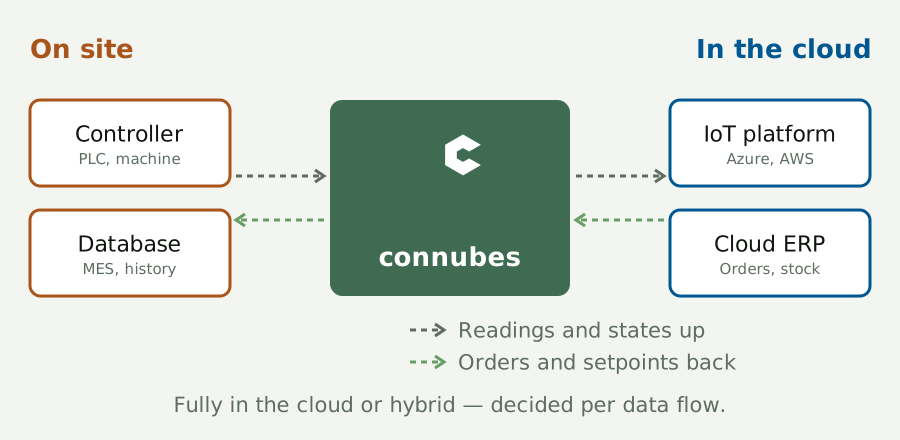
The way back belongs to it: orders and setpoints run the same data path back to the machine.
| Plug-in | What it stands for in a cloud connection |
|---|---|
| MQTT client | Lightweight, even over unreliable connections — the usual way into IoT platforms |
| REST-API | The standard way into modern cloud services and web applications |
| OPC UA client and server | The bridge to the machine, in both roles |
| Apache Kafka | Event streams in larger data architectures |
| InfluxDB | Time series, as they arise from continuous measurement |
| Network file access | For systems that only write data as a file |
In practice this means Siemens MindSphere IoT, Amazon AWS, Microsoft Azure IoT Hub, Google IoT Core, IBM Watson IoT Platform or Ewon HMS Flexy over Talk2M. The full list of all connections is under connectors.
Common questions
Answered briefly
Do I have to let my production data leave the building for this?
No. The hybrid model combines local or private servers with cloud systems — you decide per data flow what goes out and what stays in the plant.
Does connubes itself run in the cloud?
Yes, platform-independently on Windows, in Docker or in Kubernetes. It runs just as well on a machine in the plant when there is no permanent connection to the outside.
What happens when the connection drops?
That is what the Store & Forward add-on is for: values are buffered and delivered as soon as the connection is back — with no gap in the series of readings.
Does data also go from the cloud back to the machine?
Yes. Orders, setpoints and recipes run the same way back. That is exactly what separates a connection from a plain data export.