Knowledge
Industrial AI and machine learning in production
A model finds patterns in data. What makes it hard in production is rarely the algorithm — it is the question of how the data gets from the machine to the model, and what arrives there: complete, on the same clock, and tied to the machine it came from.
Prerequisites
What a model in production really needs
A model learns from what it sees. If an hour is missing from the series, it learns that hour as the normal state. If the reading does not say which machine it came from, an anomaly can later be pinned to no machine at all. So four things are decided before any model is chosen.
Two routes
Rule or model — the data path is the same
A threshold (“bearing temperature above 80 °C”) is simple, transparent and often entirely sufficient. A model pays off where the relationship is not in one number but in how several quantities behave together over time — and where there is enough history to learn from.
For the connection it makes no difference. Both need the same readings, the same clock and the same way back into production. So the choice between rule and model is not one you have to make before the data path.
The answer has to come back
A prediction that only sits in a dashboard changes nothing. It becomes useful when something follows from it: a maintenance order in the ERP, a message to the control room, a changed setpoint on the line. The way back belongs to the connection, not to the model.
The data path
How the data gets from the machine to the model
connubes collects the readings at the controller, adds timestamp and context, and puts them where the model reads them. Which plug-in does that is decided by the target system — not by the software.
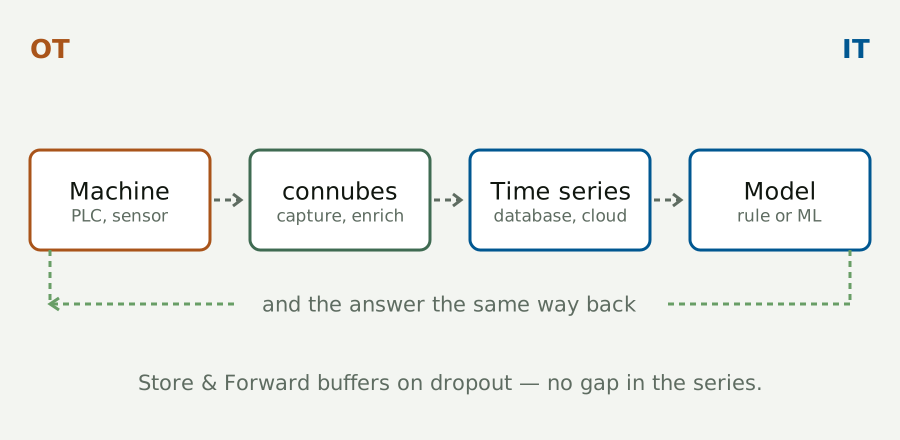
The model sits at the end of a chain with four stations — and the chain is only closed by the way back.
| Plug-in | What it stands for on the way to the model |
|---|---|
| OPC UA client and server | The way into the machine — condition data at the rate at which it arises |
| InfluxDB | The time series a model learns from and later checks against |
| Apache Kafka | Event streams when many sources deliver at once and continuously |
| MQTT client | The lightweight way into IoT and analytics platforms |
| Snowflake | Machine data in the data cloud, for long-term analysis and model training |
| REST-API | The handover to an analytics service — and the way its answer comes back |
| MCP server | An AI reaches the connected sources over one standardised interface — connubes decides what it gets to see |
| SAP systems | The maintenance order that comes out of a prediction |
| Store & Forward | Buffers on a dropped connection and delivers later — no gap in the series |
The analysis itself runs in your platform, not in connubes: Azure IoT Hub, AWS, Google Cloud, Snowflake, your own analytics server in the plant. connubes is the way there and back — and, with the MCP server, the way a language model reaches the sources directly. The full list is under connectors.
In practice
Where it usually starts in production
Three areas where the effort is manageable and the benefit shows early. They build on each other — each needs more context than the one before.
Watch condition
Vibration, temperature, current draw: deviations show up before they become a standstill. This is the entry point, because the readings are usually already at the controller.
Explain quality
Test results together with process values, batch and tool — only that link shows what an outlier was down to.
Consumption and cycle
Energy, throughput, changeover times over longer periods. Long-term storage pays off here, because the relationship does not show within one shift.
Limits
What it actually fails on
Not on the model. The recurring reasons are data quality — badly calibrated sensors and transmission errors produce false alarms, and false alarms cost trust; missing history — a machine that rarely fails delivers no examples a failure could be learned from; and legacy plant, where the measuring point has to be retrofitted first.
The first is the one a middleware can do something about: a data path that buffers instead of leaving gaps, and a timestamp that comes from one place. The other two are questions for the plant, not for the software.
Common questions
Answered briefly
Do I strictly need machine learning?
No. Rule-based approaches with thresholds and trend analysis often deliver good results already. A model pays off when the relationships are complex and enough data is available.
Does the model run in connubes?
No. connubes captures, links and transports the data; the computing happens in your analytics platform or cloud. That is deliberate: the platform can be swapped without touching the field level.
Does the data have to leave the plant for this?
No. The data path is the same whether the model runs in the cloud or on a machine in the plant. You decide per data flow what goes out.
What happens when the connection drops?
The Store & Forward add-on buffers the readings and delivers them once the connection is back — with no gap in the series that the model would otherwise learn as the normal state.
Can an AI access our production data directly?
Yes, through the MCP server. The Model Context Protocol is a standardised interface through which a language model reaches every source available in connubes, without a separate connection being built for each one. connubes links the information, presents it in context and at the same time governs which data may be handed over at all — the access decision stays with you, not with the model.
How does a prediction get back into production?
The same way, only in reverse: as a maintenance order into the ERP, as a message to the control room, or as a setpoint to the controller.